2020 官网升级中!现在您访问官网的浏览器设备分辨率宽度低于1280px请使用高分辨率宽度访问。
Time:2024-11-14
Click:64
October 3, 2024 – The Phase III clinical trial results of Zuberitamab (trade name: Anruixi®), a Class I innovative therapeutic biological product developed by BioRay Pharmaceutical Co., Ltd. (hereinafter referred to as "Bioray") , for the treatment of CD20-positive diffuse large B-cell lymphoma (DLBCL), have been officially published in the prestigious journal The Journal for ImmunoTherapy of Cancer (Impact Factor: 10.3)1. These findings, previously presented as a poster at the European Hematology Association Annual Meeting (EHA 2024), mark another significant recognition by the global academic community, showcasing the strength of "China's innovative drugs."
Robust Evidence: Zuberitamab Enables Greater Benefits for Newly Diagnosed DLBCL Patients
Zuberitamab, a chimeric monoclonal antibody (mAb) targeted against the pan-B-cell marker CD20 ,offers differentiated benefits compared to rituximab, another CD20-targeted mAb. Through modifications of its antigen-binding epitope and defucosylation, zuberitamab shows stronger antibody-dependent cell-mediated cytotoxicity (ADCC), a larger apparent distribution volume at steady state, and more sustained clearance of B cells, demonstrating better efficacy compared to other products.
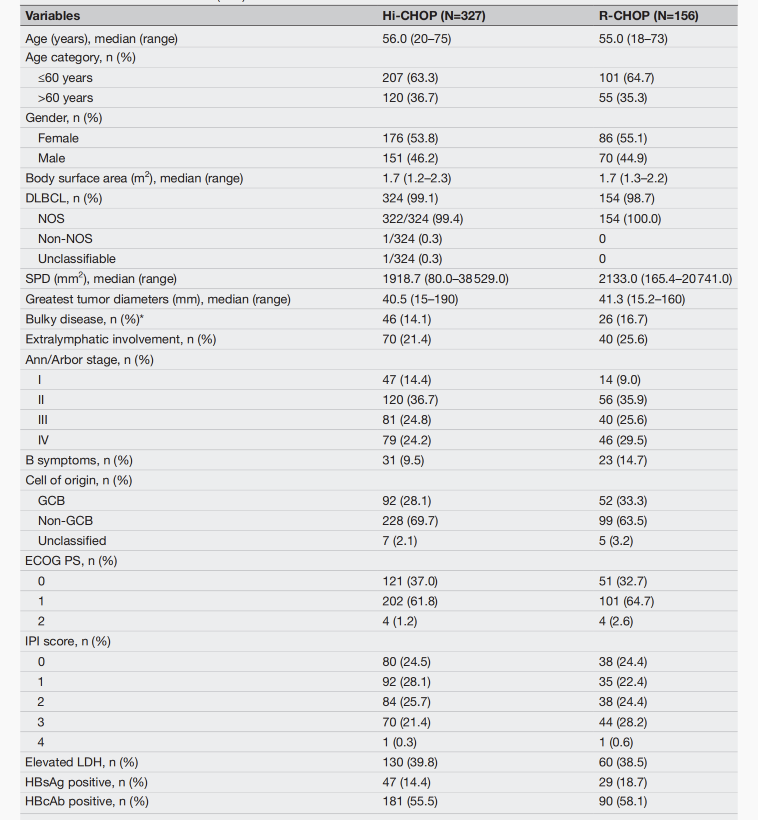
Recently, a multicenter, randomized, double-blind phase III clinical trial evaluated the efficacy and safety of zuberitamab plus CHOP (cyclophosphamide, doxorubicin, vincristine, and prednisone; Hi-CHOP) (n=327) versus rituximab plus CHOP (R-CHOP) (n=156) in patients with untreated CD20-positive DLBCL. The objective response rate (ORR) at C6D50 served as the primary endpoint. The secondary endpoints included the complete response (CR) rate at C6D50, duration of response (DOR), progression-free survival (PFS) and event-free survival (EFS) judged by blinded-independent review committee (BIRC), overall survival (OS) and safety outcomes (Figure 1)1. Patients with bulky disease, extranodal extension, B symptoms were enrolled. The final results showed that the baseline characteristics of enrolled patients in the two groups were generally well balanced (all p>0.05) (Table 1)1, also indicating that the homogeneity of the enrolled population in the present trial was relatively high as prespecified.
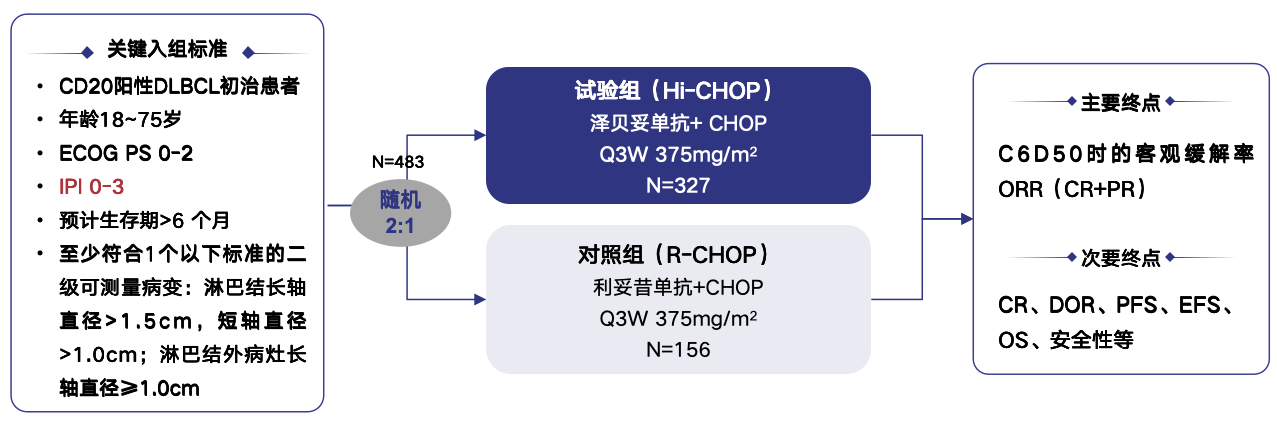
Figure 1. Study design
Table 1. Patient baseline characteristics
In the full analysis set (FAS), the primary endpoint-BIRC-assessed ORR at C6D50 was 83.5% (95% CI: 79.0% to 87.3%) for the Hi-CHOP group and 81.4% (95% CI: 74.4% to 87.2%) for the R-CHOP group, with an intergroup difference of 2.1% (95% CI: −5.2% to 9.4%). The ORR of the Hi-CHOP group demonstrated a more favorable trend than that of the R-CHOP group. Additionally, the secondary endpoint CR rate of the Hi-CHOP regimen was observed to be higher than that of the R-CHOP regimen (75.2% vs 67.9%) (p=0.092).
In the per-protocol set (PPS), the BIRC-assessed ORR at C6D50 was 95.3% (95% CI: 92.2% to 97.5%) and 93.7% (95% CI: 88.1% to 97.3%) in the PPS, with an intergroup difference of 1.6% (95% CI: −3.3% to 6.5%). The favorable trend in ORR observed for Hi-CHOP in the PPS set was consistent with that seen in the FAS set. With regard to the secondary endpoints, PPS analysis revealed a statistically significant difference that the CR rate appeared to be higher in the Hi-CHOP patients compared with those in the R-CHOP group, (85.7% vs 77.3%, p=0.038)..
Concurrently, in the full analysis set (FAS), the 1-3 year PFS and OS rates of the Hi-CHOP regimen exhibited a tendency to be superior to those of the R-CHOP regimen (Figure 2).
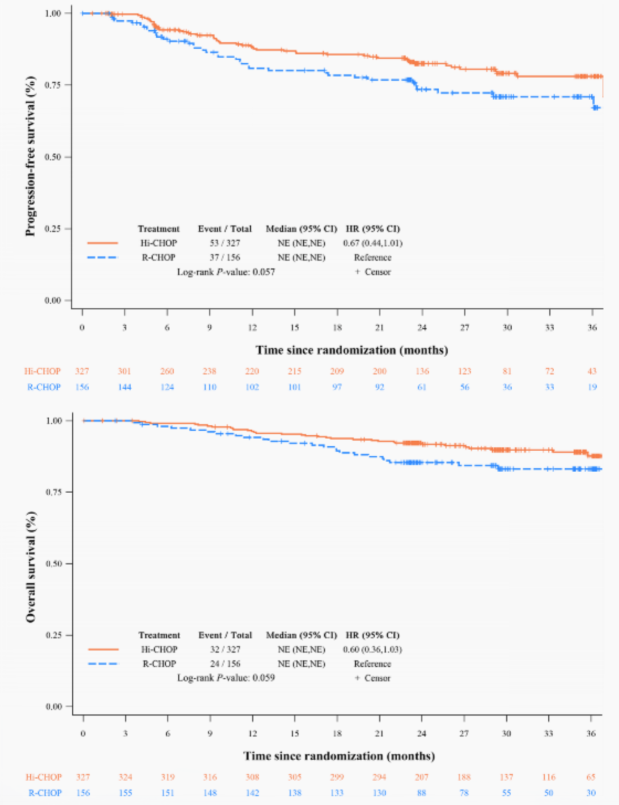
Figure 2. Kaplan-Meier curves of BIRC-assessed efficacy outcomes (PFS and OS) for patients in the Hi-CHOP and R-CHOP groups (FAS).
A subgroup analysis was conducted and the results revealed that the BIRC-assessed ORR and CR rates at C6D50 for GCB subtype patients in the Hi-CHOP group were significantly higher than that in the R-CHOP group (p=0.034 and p=0.038) Further analysis of DOR, PFS, EFS and OS for patients with the GCB subtype revealed that the Hi-CHOP regimen had significant benefits in terms of EFS (HR 0.51, 95% CI: 0.27 to 1.00; p=0.046) and OS (HR 0.25, 95% CI: 0.07 to 0.83; p=0.014), whereas DOR (HR 0.47, 95% CI: 0.18 to 1.26; p=0.126) and PFS (HR 0.41, 95% CI: 0.16 to 1.07; p=0.060) were marginally higher in the Hi-CHOP treated patients.(Table 2). For patients with DLBCL of the non-GCB subtype, the DOR, PFS rate, EFS rate, and OS rate of the Hi-CHOP regimen and the R-CHOP regimen were comparable (P>0.05).
In terms of safety, the incidence of treatment-emergent adverse events (TEAEs) (99.7% vs 100.0%, p=1.000), drug-related TEAEs (87.8% vs. 82.1%, p=0.095), serious adverse events (SAEs) (44.3% vs 50.0%, p=0.283), and treatment-related SAEs (25.1% vs. 27.6%, p=0.579) were similar between the Hi-CHOP and R-CHOP regimens.
The incidence of grade ≥3 TEAEs in the two groups was 92.0% and 92.3%, respectively, with most common TEAEs being neutrophil count decrease (75.5% vs. 75.0%), white blood cell count decrease (67.9% vs 62.8%), lymphocyte count decrease (29.7% vs. 26.9%), and anemia (12.8% vs 9.0%) (Table 2). Overall, the TEAEs of Hi-CHOP and R-CHOP were similar, and there was no significant difference in safety.
Table 2. The most common TEAEs (incidence ≥10%) in Hi-CHOP and R-CHOP regimens (%)
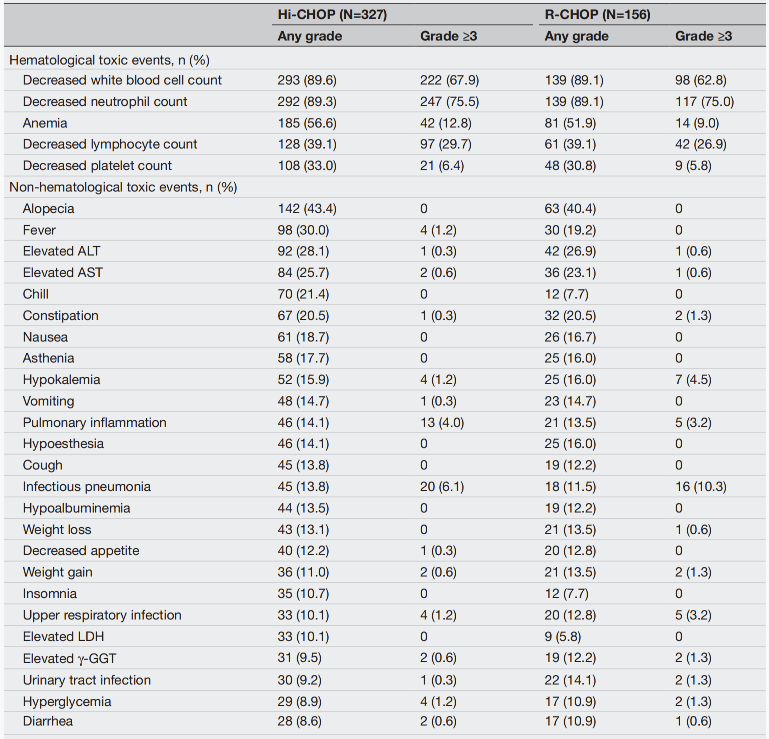
These findings highlight that zuberitamab (375 mg/m²) combined with CHOP provides a promising new first-line treatment option for Chinese patients with CD20-positive DLBCL, with improved CR rates and comparable safety to the classic R-CHOP regime.
Zuberitamab: A New First-Line Treatment Option for Patients With CD20+DLBCL
DLBCL is the most common subtype of non-Hodgkin lymphoma (NHL), accounting for 35%–50% of cases in China.2 While R-CHOP has been the standard first-line treatment for decades, offering cure rates of 50%–70%, 30–40% of the patients are either refractory or relapses after achieving complete remission.3 Despite the extensive research conducted by numerous studies, the efficacy of anti-CD20 monoclonal antibodies in the field of DLBCL has not yielded satisfactory results.4
The advent of zuberitamab brings renewed hope for better outcomes, as preclinical studies have demonstrated that zuberitamab exhibits superior antibody-dependent cell-mediated cytotoxicity (ADCC), pharmacokinetics, and pharmacodynamics compared to rituximab. The current Phase III clinical trial further validated the efficacy advantage of zuberitamab in CD20+DLBCL patients and its favorable tolerability profile.1

Dr. Haibin Wang, CEO of BioRay Biotech, stated: "For an extended period, the key challenge has been to overcome the limitations of the R-CHOP regimen and achieve a significant advancement in efficacy. The introduction of zuberitamab represents a significant solution to this issue. We are pleased to report that zuberitamab has demonstrated favorable anti-tumor activity and tolerable safety in the treatment of patients with CD20-positive diffuse large B-cell lymphoma. This highlights the great therapeutic potential and important clinical value of zuberitamab in related indications and other fields. Zuberitamab has been officially endorsed in the "Chinese Society of Clinical Oncology (CSCO) Lymphoma Diagnosis and Treatment Guidelines (2023 Edition)" and "Chinese Expert Consensus on Immunotherapy of Lymphoma (2024 Edition)" 5,6 and continues to be recommended in the "Chinese Society of Clinical Oncology (CSCO) Lymphoma Diagnosis and Treatment Guidelines (2024 Edition)" 7. Furthermore, it has successfully obtained the marketing authorization from the Instituto para a Supervisão e Administração Farmacêutica (ISAF).8 We will continue to advance clinical projects and strive to provide more diversified and effective treatment options for patients worldwide in the future.
About Anruixi® (Zuberitamab)
Anruixi® (Zuberitamab) is a novel anti-CD20 monoclonal antibody, an independently developed Class I innovative therapeutic biological product in China. It has been funded by the major new drug creation science and technology major project. The research data indicate that, in comparison to rituximab, zuberitamab exhibits a more robust ADCC effect, a greater apparent distribution volume, and a prolonged B cell clearance effect through differential modification of antigen binding epitopes and defucosylation.
About Diffuse large B-cell lymphoma (DLBCL)
DLBCL is an aggressive neoplasm derived from mature B cells. It is the common type of non-Hodgkin lymphomas (NHL) accounting for approximately 25% to 50% of all non-Hodgkin's lymphomas cases. DLBCL is highly heterogeneous and frequently involves lymph nodes and organs or tissues outside the lymphatic system.
Reference:
1.Li Z, Jiang W, Zhou H, et al. Comparison of zuberitamab plus CHOP versus rituximab plus CHOP for the treatment of drug-naïve patients diagnosed with CD20-positive diffuse large B-cell lymphoma: a phase 3 trial. J Immunother Cancer. 2024;12(10):e008895.
2. National Health Commission. Guidelines for the diagnosis and treatment of lymphoma (2022 edition).
3.Munoz J, Deshpande A, Rimsza L, Nowakowski GS, Kurzrock R. Navigating between Scylla and Charybdis: A roadmap to do better than Pola-RCHP in DLBCL. Cancer Treat Rev. 2024;124:102691.
4.Sehn LH, Martelli M, Trněný M, et al. A randomized, open-label, Phase III study of obinutuzumab or rituximab plus CHOP in patients with previously untreated diffuse large B-Cell lymphoma: final analysis of GOYA. J Hematol Oncol. 2020;13(1):71.
5.Chinese Society of Clinical Oncology (CSCO) Lymphoma Diagnosis and Treatment Guidelines (2023 Edition). [M]. People's Medical Publishing House, 2023.4.
6.Chinese expert consensus on lymphoma immunotherapy (2024 edition)[J]. Electronic Journal of Comprehensive Oncology Treatment, 2024, 10(02): 69-98.
7.7. Chinese Society of Clinical Oncology (CSCO) Lymphoma Diagnosis and Treatment Guidelines (202? Edition). [M]. People's Medical Publishing House, 2023.4.
8.https://www.isaf.gov.mo.

TO TOP